
12mm plywood uses cover a useful middle zone. The panel is easier to handle than thicker plywood, yet it offers more body than thin lining sheets. That balance suits walls, joinery, displays and interior fit outs.
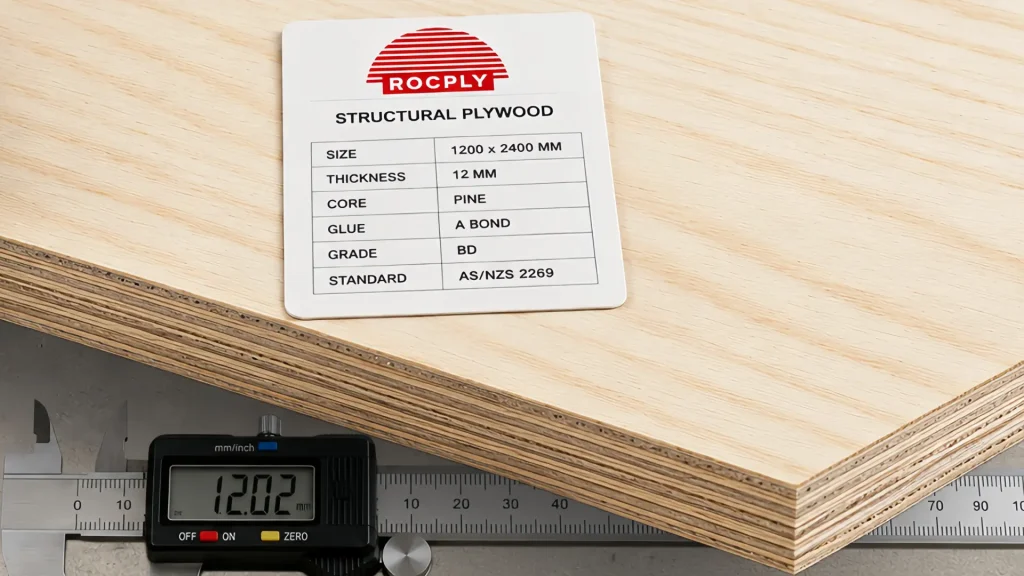
The mistake is to treat “12mm” as a complete specification. Thickness tells you panel depth, not face grade, core quality, glue bond, structural rating or fixing capacity. Success comes from matching the whole panel system to the job.
The 12mm Decision in One Sentence
Use 12mm plywood where the panel has regular support, moderate fixing demands and a clear finish plan. Move to another thickness or product when it must span farther, carry concentrated loads, hold heavy hardware or remain exposed to uncontrolled moisture.
Thickness is a geometry choice. Grade, core, bond and support turn that geometry into performance.
Start with the Support Line Not the Sheet
Many buyers begin with the board. A better process begins with the support line.
Ask where the studs, rails, cabinet partitions or frame members will sit. Then check fixing and load entry. A 12mm panel fixed to close, straight supports behaves very differently from the same panel spanning a wide opening.
Plywood gains useful stability from veneers arranged with alternating grain directions. The APA plywood overview explains this cross-laminated construction. Even so, construction quality and support layout still control the result.
Before choosing 12mm, confirm four points:
- What supports the panel?
- Where will screws, hinges or brackets be placed?
- Will the face remain visible?
- Will moisture reach the face, edges or penetrations?
A Traffic Light Map for 12mm Plywood Uses
| Application | Starting Decision | Main Check |
|---|---|---|
| Interior wall lining on regular framing | Good fit | Stud spacing, joint layout and face grade |
| Decorative feature panels | Good fit | Veneer match, flatness and finish sample |
| Cabinet backs and internal dividers | Good fit | Groove depth, screw position and core quality |
| Drawer parts and small boxes | Good fit | Edge machining and assembly method |
| Retail displays and service enclosures | Good fit | Fixing pattern and transport damage |
| Full-height cabinet carcasses | Conditional | Hardware, panel width and cabinet design |
| Long shelves | Conditional | Span, load, front edging and support |
| Structural bracing or sheathing | Conditional | Grade, marking, orientation and fixing schedule |
| Flooring or trafficable platforms | Not a default choice | Engineered floor specification |
| Permanently wet exterior work | Not a default choice | Product type, treatment and weather detailing |
This table is a starting point, not a substitute for design data. The same thickness can be sold as decorative, furniture or structural plywood, and those products are not interchangeable.
These 12mm plywood uses work best when the support layout, panel grade and service conditions are confirmed before installation.
Walls Need a Joint Plan Before a Panel Plan
Twelve millimetre plywood can work well as an interior wall lining because it creates a firm surface and tolerates normal site handling. It can also support shadow gaps, expressed joints and visible layered edges.
However, a wall panel is only as clean as its support and joint layout. Uneven framing can show through the surface. Unsupported edges can move, and poorly planned joints become more visible after finishing.
WoodSolutions notes that internal panelling usually acts as an appearance product rather than a structural element. Its interior panelling guidance also advises confirming sheet dimensions and coverage before installation.
For visible walls, specify face veneer, grain direction, joint width, edge support, fixing and finish. Do not treat a decorative lining as a hidden structural element.
Joinery Works Best When 12mm Has a Defined Role
In joinery, 12mm plywood is most successful when it performs a specific component role. It can suit cabinet backs, dividers, drawer sides, small carcasses, plinth skins, display boxes and internal partitions.
For joinery factories, the most reliable 12mm plywood uses are defined components such as cabinet backs, internal dividers, drawer sides and display boxes.
It is less convincing as a universal replacement for every 16mm or 18mm cabinet component. Wide cabinet sides, heavily loaded shelves and hardware-rich doors may need more thickness, closer support or a different construction.
The core matters as much as the face. Voids can appear during routing, while uneven thickness can affect grooves and CNC settings. Before production, test a sample with the actual tools and hardware.
Use the plywood quality inspection process to record the sample result and define what passes before repeat production begins.
Fit Outs Reward Panels That Reduce Site Decisions
Commercial fit outs often combine wall linings, service boxes, column wraps, display fixtures, access panels and temporary partitions. In these projects, 12mm plywood can reduce the number of panel types carried on site.
That convenience has value only when one specification truly suits the repeated tasks. A single 12mm SKU should not be forced into shelves, load-bearing platforms or wet service merely to simplify purchasing.
- A clean-face 12mm panel for visible walls and displays
- A utility-face 12mm panel for concealed boxes and backing
- A certified structural product where the system requires it
- A thicker panel for long shelves, heavy hardware or trafficable work
This reduces site confusion without forcing one board into every job.
Four Failure Points Decide Whether 12mm Feels Right
Span
Panel depth does not control deflection by itself. Span, load, grain direction and support conditions work together. A short supported panel can feel solid, while a long shelf in the same material may move.
Edge
Twelve millimetres leaves less material around some fixings than an 18mm panel. Screw type, pilot hole, edge distance and tightening control become more important.
Moisture
An exterior or Type A bond protects the glue line under specified conditions. It does not make an unfinished panel waterproof.
Surface
A panel for clear coating needs a different face standard from a hidden backing sheet. Choose the face and back grade by what the user will see, not by thickness. The plywood grades guide separates appearance from structural performance.
The Structural Boundary Must Stay Clear
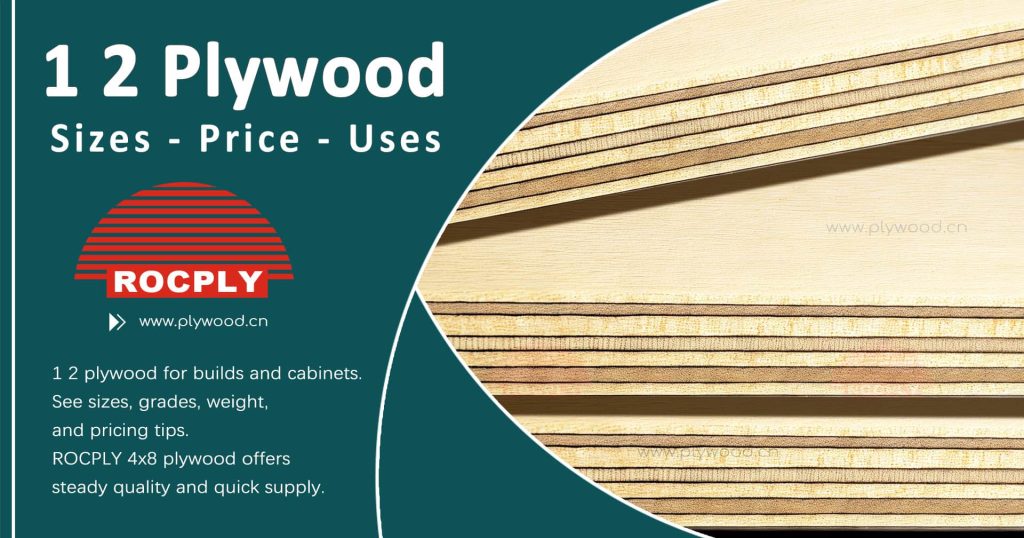
Twelve millimetre structural plywood can form part of some engineered wall or roof systems. That does not mean every 12mm sheet is structural, or that the thickness suits every span.
The EWPAA Structural Plywood and LVL Design Guide shows that selection depends on stress grade, plywood construction, face-grain direction and support spacing.
For structural work, confirm the compliance standard, stress grade, panel marking, veneer construction, orientation, support spacing, fixing schedule and exposure conditions. Do not convert a furniture or lining recommendation into a structural recommendation without product data.
When 9mm or 18mm Is the Better Decision
Choose 9mm when the panel is mainly a lightweight lining, backing or decorative skin with close support and low fixing demand.
Choose 18mm when the part needs more screw embedment, greater stiffness, longer shelf spans or a more substantial cabinet component.
Twelve millimetres suits projects needing more body than a thin lining without the weight of a heavier panel throughout.
Use the plywood thickness chart to compare thickness bands, then return to the application and support layout before approval.
Write a 12mm Specification That a Factory Can Repeat
A purchase line should not read only “12mm plywood.” Include:
- Final application
- Structural or non-structural product type
- Finished sheet size
- Nominal thickness and tolerance
- Face and back grade
- Veneer species or appearance requirement
- Core type and visible edge requirement
- Glue bond and service environment
- Machining or fixing requirement
- Surface finish
- Pack quantity and protection
- Product marking and documents
Attach the cut list for repeated components. Approve a face sample when the panel will remain visible. Define wrapping, corner protection and pallet support before sea shipment.
The plywood sheet size guide can help align panel dimensions with cutting yield and packing.
Straight Answers for Site and Factory Teams
Is 12mm plywood suitable for wall panels?
Yes, it can suit many interior wall linings when framing, joint layout, face grade and fixing are planned. Structural wall roles require a certified system.
Can 12mm plywood be used for cabinet carcasses?
It can suit smaller or well-supported carcasses, backs and dividers. Full-height units, heavy hardware and wide components need a design check.
Is 12mm plywood suitable for shelves?
It can work for short shelves with close support. Longer or heavily loaded shelves may need thicker plywood, front stiffening or more supports.
Is 12mm plywood waterproof?
No. Bond classification and surface protection are separate issues. Faces, cut edges and penetrations need detailing that matches the exposure.
Specify the System Not Just the Thickness
The strongest use of 12mm plywood is not as a universal board. It is as a controlled component inside a clear wall, joinery or fit-out system.
The best 12mm plywood uses come from treating the sheet as one part of a complete system that includes supports, fixings, finish and moisture protection.
Start with supports, loads, fixing and finish. Then select the grade, core, bond and sheet format. ROCPLY can prepare a 12mm plywood sample and specification when the application, finish, quantity and delivery market are defined.
Need a 12mm Plywood Sample and Specification
Send your application, finish requirement, sheet size, quantity and destination market. ROCPLY can prepare a panel recommendation, sample plan, packing specification and quotation.
Post time: Jul-20-2026