
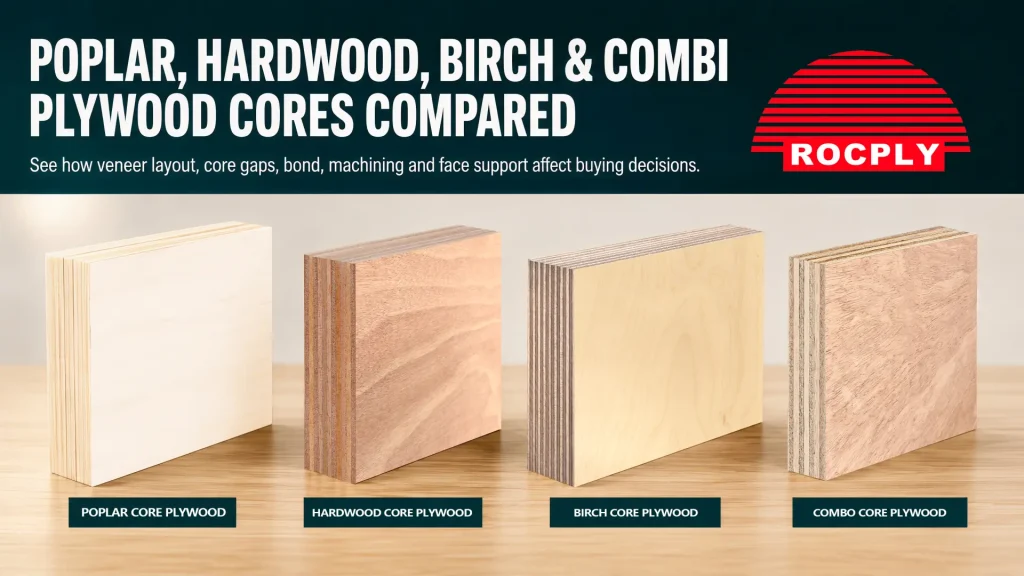
Plywood core types are often sold with simple labels such as poplar, hardwood, birch or combi core. Those labels help, but they do not tell a buyer enough to predict machining, fixing, weight, flatness or structural suitability.
The better procurement question is not “Which core name is best?” It is “What core construction has been specified, controlled and proven for this component?” A trade name should begin the discussion. It should never finish the specification.
The Core Name Is Only the First Line
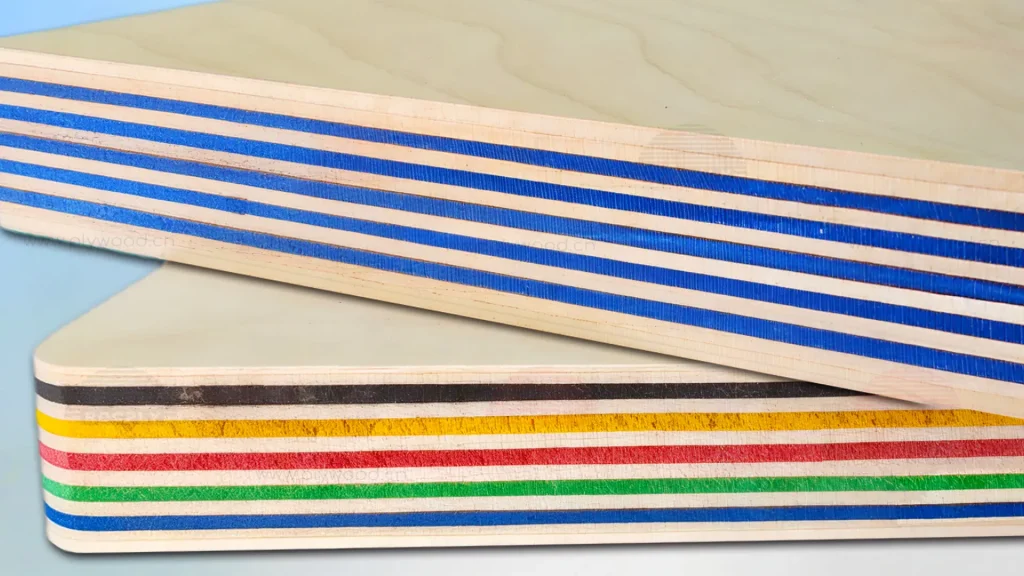
A core label usually describes the main inner veneer species or a broad species group. It may not explain veneer thickness, the number of plies, whether species alternate, how gaps are controlled or whether each production batch follows the same lay-up.
“Hardwood core” is especially broad. Hardwood is a botanical category, not one fixed density or performance level. “Combi core” is also a trade term. One supplier may alternate poplar and eucalyptus veneers. Another may use a different mixed schedule.
Therefore, compare construction schedules rather than names alone.
Read Plywood Core Types as a Construction Schedule
Plywood is formed from veneers bonded in layers, normally with adjacent grain directions crossing each other. The APA plywood overview describes this cross-laminated construction.
For trade buying, read the core through six fields:
| Core field | What it tells the buyer | What to request |
|---|---|---|
| Species schedule | Which veneers form the inner build | Species by layer or defined species groups |
| Veneer geometry | Thickness and continuity of each ply | Nominal veneer schedule and permitted repairs |
| Lay-up balance | Whether the panel is symmetrical around its centre | Lay-up drawing or cross-section sample |
| Gap and overlap control | Risk around screws, grooves and exposed edges | Agreed defect limits and reference samples |
| Bond system | Adhesive performance for the service condition | Bond class, test basis and product documents |
| Face-core interface | Support beneath the decorative or working face | Under-face veneer quality and sanding control |
These plywood core types can only be compared fairly when the six fields are visible. A buyer comparing only “poplar versus hardwood” may be comparing two unknown constructions.
Five Core Families Buyers Commonly Meet
Poplar Core
Poplar-core plywood is commonly considered when lower panel weight and interior processing matter. Yet the word poplar does not guarantee a clean edge or stable thickness.
Ask whether the panel uses full poplar veneers or mixed species under the face. Check a machining sample when screws, grooves or exposed edges matter.
Dense Hardwood and Eucalyptus Core
Dense hardwood or eucalyptus-core panels are often considered for robust components and demanding fixings. Higher density can also change weight, cutting effort and tool wear.
Ask for the actual species, lay-up, tolerance and finished component trial.
Birch Core
Birch-core plywood is often selected where fine veneers, clean machining and an exposed laminated edge form part of the product value. A birch face does not prove a full birch core.
The RFQ should separate face species from inner-ply species. Buyers should also verify origin, certification scope and the exact construction supplied.
Combi or Mixed Core
A combi core may balance weight, cost, machining and veneer availability. The risk is an undefined mixture that changes without buyer approval.
Write the alternating species or permitted layer positions into the specification. Do not accept “mixed hardwood” as the only core description for repeat production.
Special Core Architectures
Veneer-core plywood, lumber-core panels and blockboard do not share the same internal architecture. WoodSolutions describes ordinary plywood as at least three plies with alternate grain directions.
Lumber-core and blockboard products use timber strips or battens inside, so they should not replace veneer-core plywood without a design and process review.
The Face Core Interface Is Where Many Orders Fail
Buyers often inspect the centre of the edge and ignore the layers directly below the face veneer. Yet the under-face layer affects sanding support, impact resistance, local machining and the risk of surface telegraphing.
A thin decorative face over an irregular under-face veneer may later show dents, sanding-through or breakout near routed details.
For clear finishes, painted furniture and laminated panels, request:
- A minimum face veneer requirement
- A defined under-face veneer quality
- Limits for repairs beneath visible surfaces
- A sanding and calibration requirement
- An approved finished-surface sample
The ROCPLY plywood grades guide should remain the main page for face appearance. This page owns internal construction and the face-core relationship.
Match Core Architecture to the Factory Outcome
The most useful plywood core types are chosen by the factory outcome, not by a general good-better-best ranking.
| Factory outcome | Core features to prioritise | Evidence to request |
|---|---|---|
| Clean CNC routing | Continuous inner veneers and stable thickness | Routed sample using production settings |
| Reliable screw fixing | Controlled gaps around planned fixing zones | Screw and connector trial |
| Exposed plywood edge | Regular veneer schedule and visual continuity | Finished edge sample from the batch |
| Low handling weight | Suitable species and construction without losing required performance | Sheet weight range and pack data |
| Flat laminated component | Balanced lay-up, moisture control and even calibration | Flatness check before and after lamination |
| Structural component | Certified grade, defined construction and correct orientation | Product marking, certificate and design data |
A core can suit one outcome and fail another. A cabinet back does not need the same core decision as a hinge-rich side.
Core Selection by Application
Cabinet Carcasses
Focus on thickness consistency, fixing zones, groove quality and flatness. Approve the panel with real connectors, hinges and edge-banding conditions.
Shelves and Fixtures
Focus on panel construction, support layout and the finished load case. Core species alone cannot establish a universal shelf span.
Visible Plywood Edges
Focus on regular veneer thickness, repair visibility, gap control and colour contrast. Approve a finished edge rather than only an unfinished sample.
Wall and Ceiling Linings
Focus on flatness, face-core support, sheet weight and finish. Decorative lining should not be presented as structural simply because it has a dense core.
Structural Plywood
For structural work, core construction must sit inside a certified product system. The EWPAA Structural Plywood and LVL Design Guide separates manufacturing process, timber species, veneer quality, stress grade and design requirements.
A supplier core name cannot replace the panel mark or design data. Buyers requiring rated panels should compare the construction with the ROCPLY structural plywood range.
Concrete Formwork
Focus on bond, lay-up balance, edge integrity and repeated moisture cycling, as well as the film or overlay. A dense core does not compensate for weak glue lines or poor edge sealing.
What No Core Gaps Should Mean in a Contract
“No core gaps” sounds clear, but it is often too vague for inspection.
A commercial veneer is a natural material. The contract should define what matters to the application. A CNC buyer may care about gaps intersecting grooves or hinge cups. An exposed-edge buyer may care about visible voids on every cut edge.
- Maximum permitted gap dimensions where applicable
- Whether isolated and repeated gaps are treated differently
- Critical no-gap zones for screws, grooves or visible edges
- The sampling method and reference sample
- The action for isolated, repeated and batch-wide findings
Use the ROCPLY plywood quality inspection process for the sampling and pass-review-hold procedure. This article defines what the inspection team should verify.
Build a Core Passport for Every Repeat Order
A core passport is a one-page construction record attached to the quotation, approved sample and purchase order.
- Product and application
- Face and back species
- Inner-ply species schedule
- Nominal veneer schedule
- Total thickness and tolerance
- Lay-up symmetry
- Core-gap and overlap requirements
- Bond class
- Moisture requirement where relevant
- Machining or fixing trial
- Approved edge and face photographs
- Pack identification and change-control rule
If the factory changes a species, layer position or core schedule, the buyer should approve the revision before production.
Questions Trade Buyers Ask
Which plywood core types are best for cabinets?
There is no universal best core. Cabinet sides, backs, doors and shelves create different demands. Select by fixing, machining, flatness, edge appearance, weight and finish.
Is hardwood core always stronger than poplar core?
No single conclusion follows from those names alone. Actual species, veneer quality, lay-up, thickness, bond and test basis all affect performance.
Does a birch face mean full birch plywood?
No. The face species and inner-ply species must be specified separately. Request a cross-section sample and written construction schedule.
Is combi core lower quality?
Not necessarily. A defined mixed lay-up can serve a clear cost, weight or processing objective. An undefined lay-up is the larger procurement risk.
Can core type prove structural suitability?
No. Structural suitability requires the relevant product grade, marking, certification and design information. The core description is only one part of the product.
Buy a Defined Lay-Up Not a Trade Label
The right plywood core types are the constructions that match the finished component and remain consistent from sample to shipment.
Ask for the species schedule, veneer geometry, lay-up balance, defect limits, bond and face-core interface. Then validate the panel through machining, fixing, finishing or certified structural evidence.
ROCPLY can prepare a core passport, cross-section sample and component-based specification. Send the application, finish, machining method, required edge quality, quantity and delivery market to begin the comparison.
Need a Plywood Core Passport
Send your application, face requirement, machining method, visible-edge standard, quantity and destination market. ROCPLY can prepare a core comparison, cross-section sample, packing plan and quotation.
Post time: Aug-10-2026