
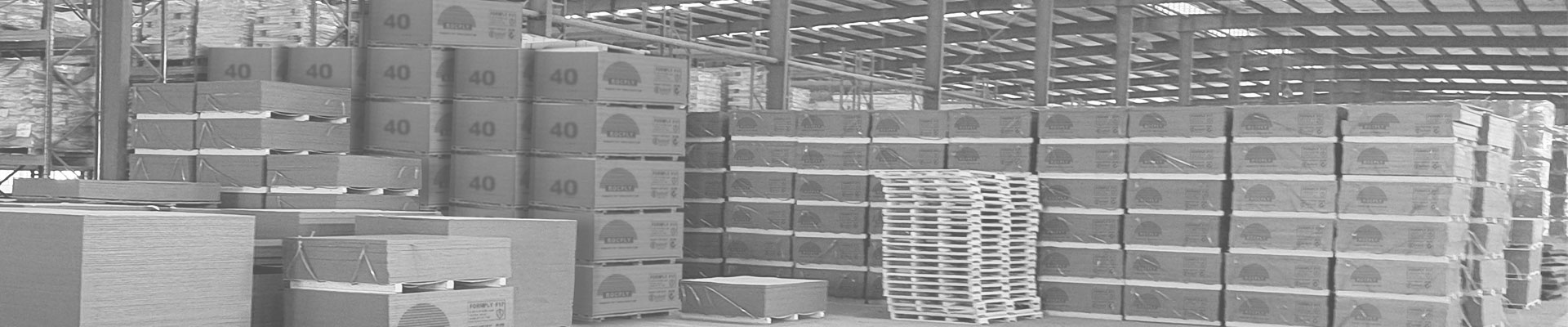
Plywood vs particle board is not a simple better-or-worse decision. Plywood often suits shelves, hardware-heavy carcasses, exposed edges and furniture that faces repeated handling. Particle board often suits laminated cabinets, short supported panels and cost-controlled volume production in dry interiors. Therefore, the right choice depends on the component, span, hardware, finish, moisture risk and total finished cost.
As a result, furniture factories should compare approved samples before a repeat order. A material name alone does not define density, core quality or fixing performance.
ROCPLY supplies plywood panels and particle board for furniture and trade programs.
Quick answer for furniture buyers
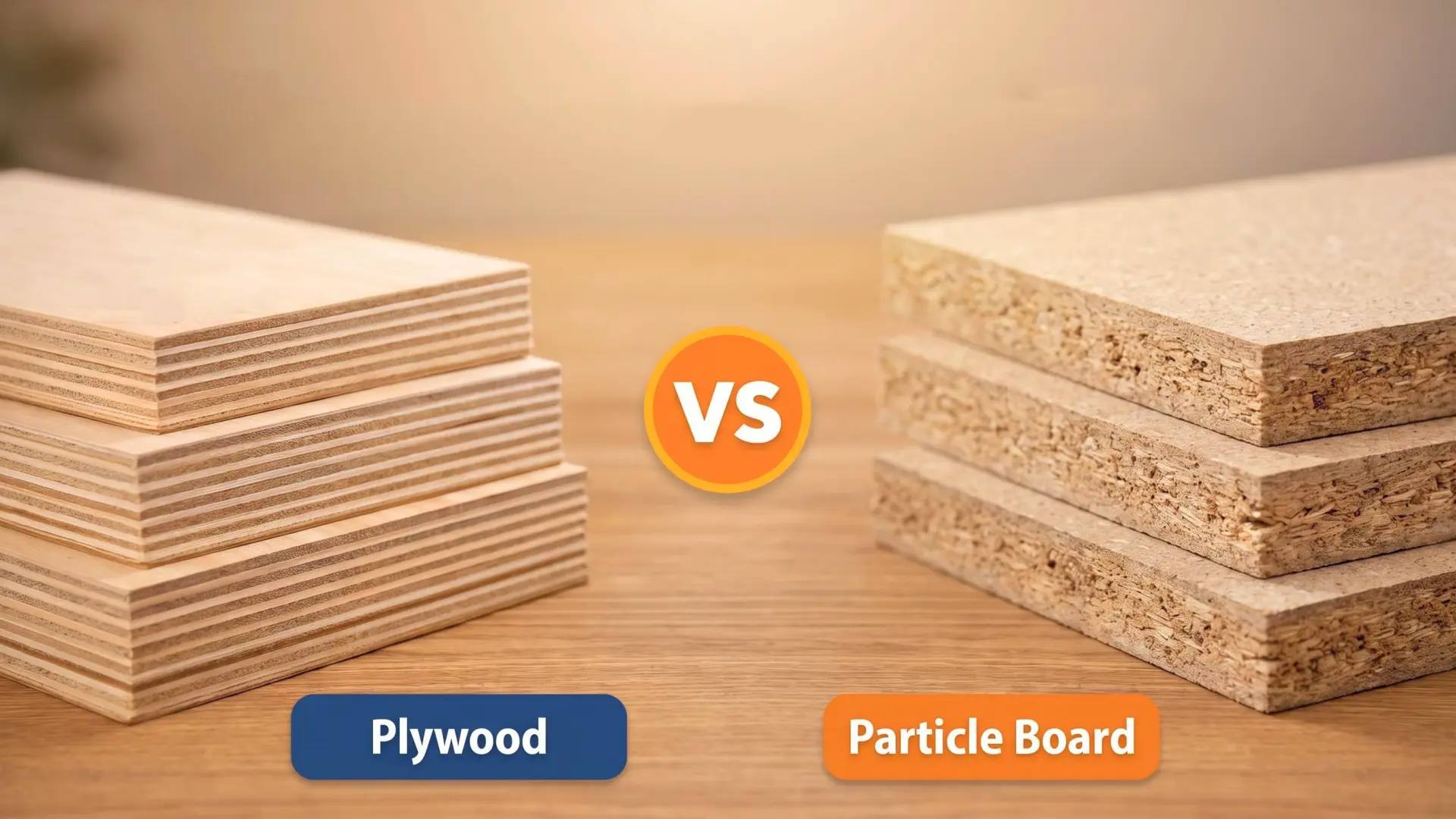
For a plywood vs particle board decision, choose plywood when the part needs dependable edge fixing, longer shelf spans, impact resistance or a visible timber face. Choose particle board when the part stays dry, carries a decorative overlay and uses a design built around its density and fixing limits. Many factories use both materials.
How panel construction changes performance
Plywood uses thin wood veneers bonded in alternating grain directions. However, species, veneer thickness, lay-up, bond and core gaps all change its performance. The APA plywood overview describes cross-laminated veneer construction and lists furniture among common applications.
Particleboard uses wood particles, resin, heat and pressure. Fine particles usually form the faces, while larger particles form the core. As a result, this structure creates a flat substrate for melamine, laminate and timber veneer. WoodSolutions explains particleboard as an interior panel used for furniture, cupboards and veneer substrates.
Construction explains tendencies, not guarantees. Poor plywood can machine badly, while correctly specified particle board can perform reliably.
Plywood vs particle board comparison table
| Buying factor | Plywood | Particle board | Better starting choice |
|---|---|---|---|
| Cabinet carcasses | Strong option for hardware and repeated handling | Efficient for laminated, well-supported carcasses | Depends on design and price target |
| Long shelves | Often stiffer at a comparable thickness | Usually needs shorter spans or added support | Plywood |
| Screw and hinge fixing | Often more tolerant with a sound veneer core | Needs suitable screws, pilot details and edge distances | Plywood for demanding fixing |
| Flat decorative surfaces | Veneer quality can vary with grade | Uniform substrate for melamine and laminate | Particle board |
| Exposed edges | Layered edge can become a design feature | Normally requires edge banding or a profile system | Plywood |
| CNC cutting | Cuts well when the face and core are controlled | Consistent cutting in approved production settings | Sample test both |
| Moisture accident | Performance depends on bond and edge protection | Standard grade can swell after water entry | Suitable specified grade only |
| Transport and impact | Often handles knocks well with a sound core | Edges and corners need strong packaging | Plywood for mobile furniture |
| Panel consistency | Varies with species, veneers and lay-up | Often uniform across the sheet | Particle board |
| Sheet price | Often higher | Often lower for standard interior board | Particle board |
Therefore, use this table as a first filter. Approve the actual grade, thickness and hardware system before production.
Choose the panel by furniture component
Cabinet carcasses and flat-pack furniture
For example, plywood suits carcasses that carry heavy fittings, move between sites or need repeated assembly. However, core gaps and uneven thickness can disrupt drilling and edge finishing.
In contrast, particle board suits flat, laminated carcasses with standardised machining. Confirm density, internal bond, tolerance and hardware details. The ROCPLY particle board range includes standard and moisture-resistant options.
Shelves and horizontal parts
Shelf performance depends on thickness, span, load and support. Plywood often suits longer shelves. Particle board can work with shorter spans, front rails or close supports. Therefore, approve the complete shelf design.
Doors, fronts and visible surfaces
Meanwhile, particle board with melamine or laminate gives a consistent, factory-ready face. Plywood supports real-wood veneer, clear coating and exposed layered edges. If painted routed doors lead the project, compare both materials with MDF in the Plywood vs MDF guide.
Tables, retail fixtures and mobile furniture
Plywood often suits worktables, displays and transportable units that face impact. Particle board suits fixed desks and wardrobes when the design protects edges.
Screw holding and hardware need a test
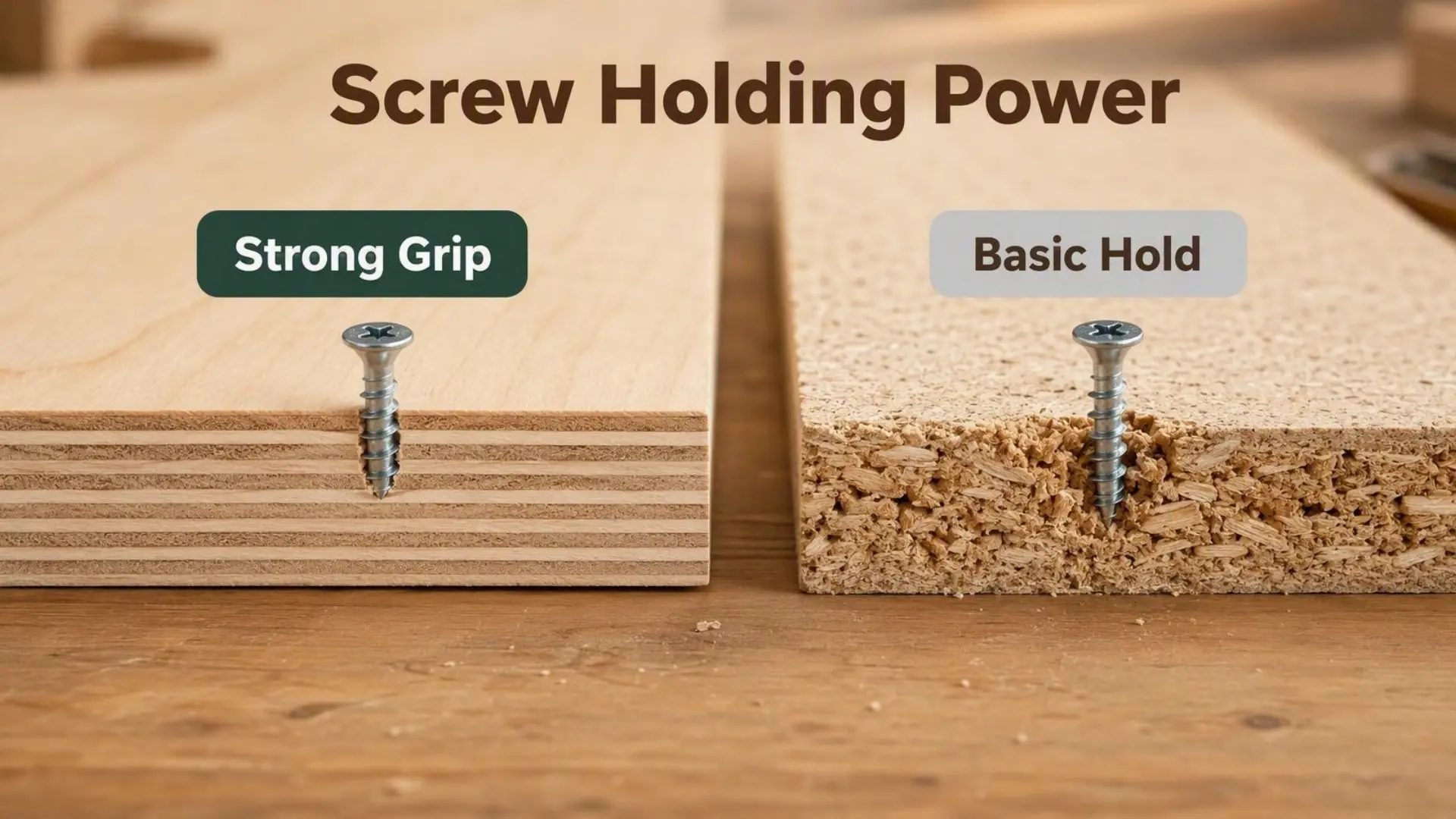
A plywood vs particle board fixing test should use the final hardware. For example, problems often start with the wrong screw, an undersized pilot hole, poor edge distance or excess driver torque.
Plywood usually gives screws continuous veneer layers to engage. Yet voids, thin face veneers and low-density cores can weaken the result. Therefore, particle board needs fasteners designed for reconstituted panels. Confirmat screws, inserts, cams and dowels can work well when machining stays controlled.
Prepare a production sample with the intended hinge, screw and drilling pattern. Then test face fixing, edge fixing and repeated assembly. Finally, record the approved drilling and torque settings.
Edges and surface finishing change the cost
Plywood can show a natural veneer face or layered edge. Still, a premium clear finish needs selected faces, controlled patches and a tight core. Lower grades may need filling, sanding or full edge treatment.
Particle board normally receives melamine, laminate or timber veneer. Its flat surface supports repeatable pressing. However, exposed edges need banding or another protective detail. Poor banding can reveal the core and allow cleaning water to enter.
Therefore, compare finished components rather than raw sheets. Include pressing, edge banding, rejected parts and touch-up labour.
Moisture risk can reverse the decision
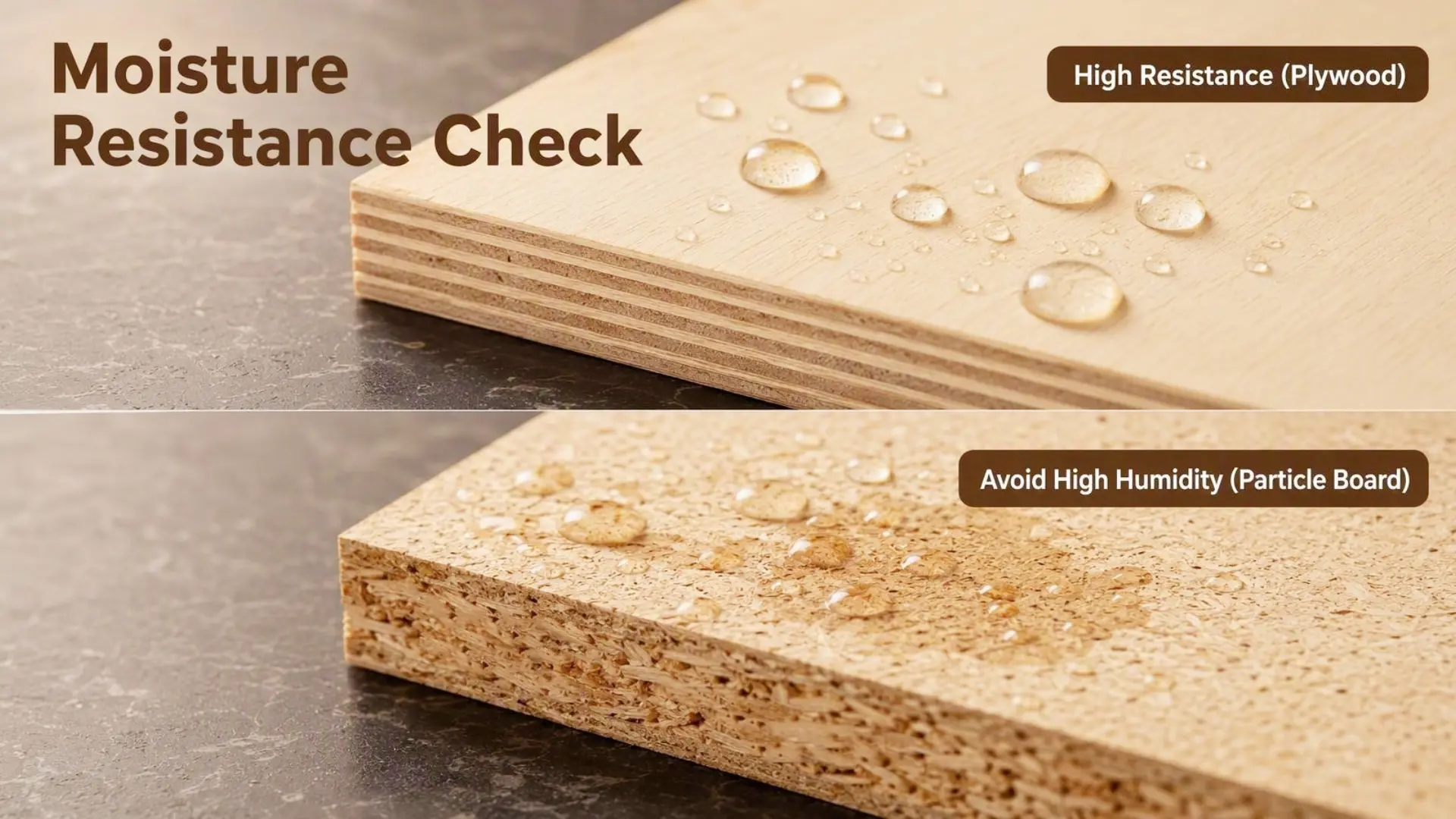
The plywood vs particle board choice changes when moisture enters the risk map. Therefore, standard particle board belongs in dry interior service. Moisture-resistant board improves performance for selected humid interiors, but it is not waterproof. The current AS 1859.1 particleboard standard distinguishes dry and moisture-resistant service conditions.
Likewise, plywood is not automatically waterproof. Interior plywood supplied to AS/NZS 2270 is intended for fully protected interior use. Buyers must match bond, face, finish and edge protection to the real exposure.
For kitchens, laundries and commercial cleaning zones, map likely leaks and wet edges. Then seal cut-outs and protect the floor junction. Also confirm how the panel can dry after an incident.
Compare weight, packing and transport
Do not assume particle board is always lighter. Density varies, while plywood weight changes with species and core. Instead, request kilograms per sheet for the exact thickness and size.
Heavy packs affect payload and handling. Protect particle board corners and plywood faces with flat bearers, dry wrapping and clear pack labels.
Compare total finished cost
Particle board often wins on raw sheet price and decorative surface consistency. Plywood may reduce support, hardware or damage costs in demanding parts. Neither advantage applies to every design.
A plywood vs particle board cost review should calculate cost per approved component. Include sheet yield, machining, edge treatment, hardware, rejects, packing, freight and warranty risk. A mixed-material bill of materials may create the best result.
Furniture panel buying checklist
- Name every component and its finished dimensions.
- State the expected load, shelf span and support layout.
- Identify all hinges, screws, cams, dowels and inserts.
- Define the surface as raw, painted, veneered, laminated or melamine faced.
- Specify edge treatment and cut-out sealing.
- State dry, humid or moisture-resistant service requirements.
- Confirm thickness tolerance, flatness, density or plywood core construction.
- Request the relevant standard, emission evidence and product marking.
- Approve machining, fixing and moisture samples before mass production.
- Confirm sheets per pack, pack weight, protection and destination.
Questions furniture buyers ask
Is plywood better than particle board for cabinets
Plywood is often better for demanding shelves, heavy hardware and repeated handling. Particle board can be better for dry, laminated carcasses built around standardised fittings and close support.
Does plywood hold screws better than particle board
Quality plywood often gives more tolerant fixing zones. However, results depend on the plywood core and the exact screw detail. Particle board can perform well with suitable fasteners, pilot holes and torque control.
Can particle board be used in kitchens
Yes, when the grade, surface, edge sealing and installation suit the exposure. Use moisture-resistant board where specified. Do not treat it as waterproof, and protect leak-prone edges.
Which panel is lighter
It depends on species, density, thickness and sheet size. Compare the declared kilograms per sheet. Light-core plywood can weigh less than dense particle board, but this is not universal.
Can equal-thickness panels be substituted
Not automatically. Equal thickness does not provide equal stiffness, fixing behaviour, weight or moisture response. Recheck spans, hardware, machining and finished cost before changing material.
Request a furniture panel comparison sheet
ROCPLY can prepare a project-specific plywood vs particle board comparison for a furniture or cabinet program. Share the component list, finish, thickness, hardware, exposure, quantity, packing method and destination market.
Contact ROCPLY to request the Furniture Panel Comparison Sheet. The team can align material options with samples, production checks, packing details and quotation inputs.
Post time: Aug-31-2026