

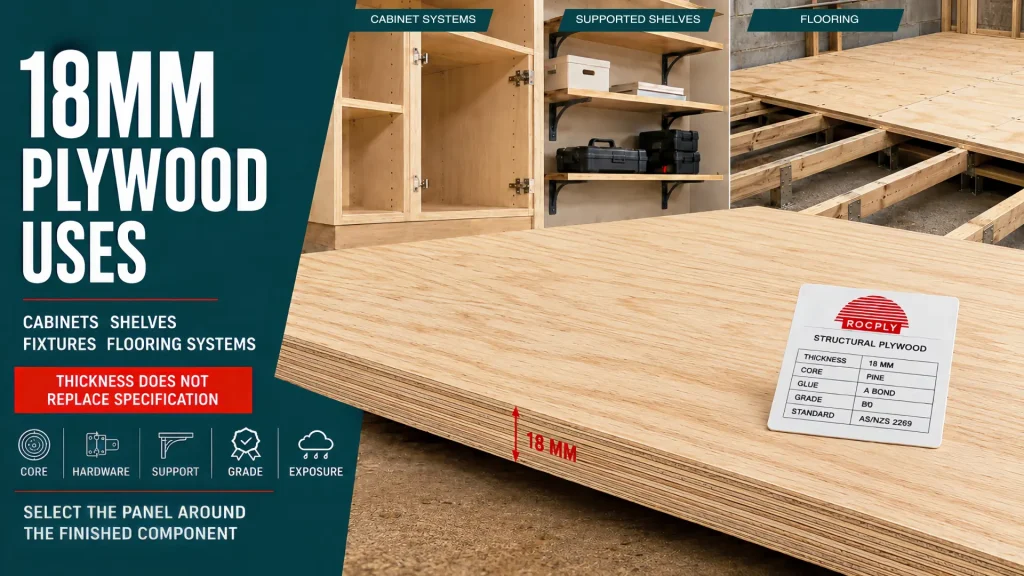
18mm plywood uses often begin where thinner panels start to feel limited. The added depth gives cabinet parts more body, shelves more bending resistance, and fixings more material to engage. Yet 18mm is still only a thickness. It does not confirm structural grade, core quality, glue bond, surface finish, or moisture durability.
A better buying decision asks what the thickness must achieve inside the finished system. That may involve stiffness, hardware, machining, edge appearance, or floor design.
What 18mm Changes in a Finished Component
The professional value of 18mm plywood is not simply that it is “strong.” Its depth changes several parts of the design at the same time.
It can improve bending resistance, give screws and dowels more working material, and allow deeper grooves or rebates. It also creates a more substantial exposed edge where the veneer layers form part of the design.
Plywood is made from cross-laminated veneers. The APA plywood overview explains that this construction supports dimensional stability and a useful strength-to-weight ratio. However, thickness does not remove the need to check grade, orientation, support, and service conditions.
The Five Budgets Behind 18mm Plywood Uses
Think of each panel as carrying five design budgets.
| Design budget | What 18mm can improve | What still needs checking |
|---|---|---|
| Bending budget | More panel depth than thin lining sheets | Span, load, grain direction, support spacing |
| Fixing budget | More material around screws and hardware | Core quality, pilot holes, edge distance |
| Machining budget | Greater allowance for grooves and rebates | Remaining wall thickness and veneer breakout |
| Finish budget | A substantial exposed edge and stable face | Face grade, sanding, veneer match, coating |
| Handling budget | A solid component for repeated use | Sheet weight, lifting, pallet and site access |
This approach is more useful than calling every 18mm sheet “heavy duty.” A panel can be thick and still have the wrong face, core, bond, marking, or construction.
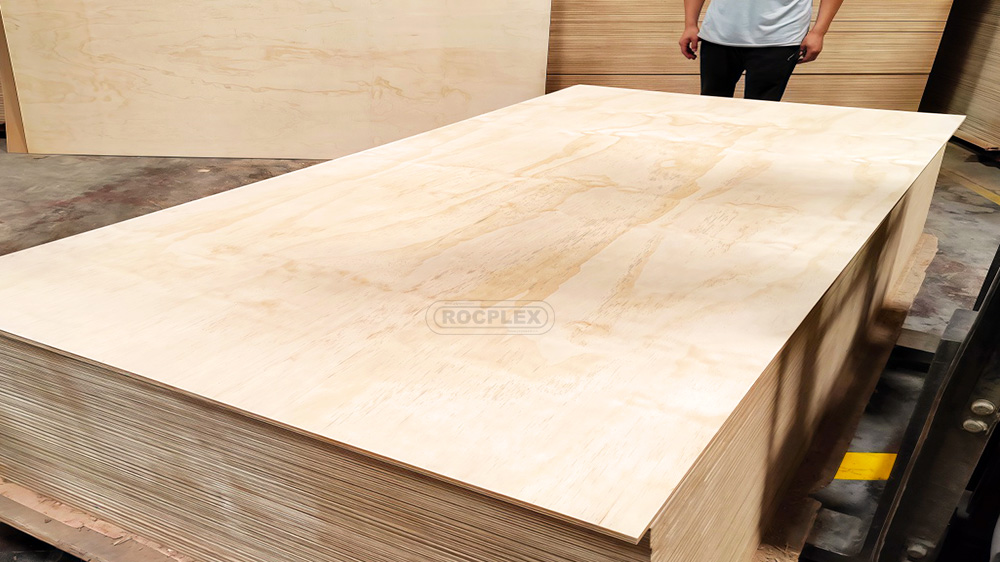
Where 18mm Usually Earns Its Place
| Application | Starting view | Main design question |
|---|---|---|
| Cabinet sides and bases | Strong candidate | What hardware and joint method will be used? |
| Shelves with regular support | Strong candidate | What load and unsupported length apply? |
| Workbench and fixture panels | Strong candidate | Is the surface sacrificial, coated, or visible? |
| Drawer fronts and robust boxes | Strong candidate | Will edges be exposed or covered? |
| Retail and exhibition fixtures | Strong candidate | How often will the unit be moved or rebuilt? |
| Structural flooring | Conditional | Is the panel rated, oriented, supported, and fixed correctly? |
| Wall and roof sheathing | Conditional | Does the design call for this grade and thickness? |
| Permanently wet exterior use | Not a thickness-only decision | Are bond, treatment, sealing, and detailing suitable? |
These 18mm plywood uses work best when the product is selected as a component, not as a generic board.
Cabinet Systems Need Hardware Logic
Cabinet factories often choose 18mm because it aligns well with common hardware, grooves, dowels, screws, and edge treatments. The thickness can create a solid carcass and a useful base for hinges, connectors, and adjustable shelf fittings.
However, the core still controls machining quality. A clean face cannot prevent breakout around a hinge cup if the internal veneers contain large gaps. Uneven thickness can also affect CNC programs, dado joints, and edge-banding pressure.
For repeat production, approve the panel with the real hardware and machine settings. Cut a hinge cup, drill shelf pins, make a groove, install a connector, and inspect the finished edge. The ROCPLY quality inspection process provides a useful approval sequence.
The best 18mm plywood uses in cabinets are defined parts with known hardware, support, and finish requirements. They are not a reason to use the same panel for every door, back, drawer, and decorative face.
Shelves Are a System Not a Thickness Contest
A thicker shelf generally has more bending resistance than a thinner shelf made from the same panel construction. Yet shelf performance still depends on unsupported length, load position, grain direction, edge treatment, and connection method.
A front lip, timber edge, steel support, or centre divider can change how a shelf behaves. So can a heavy load placed near the middle rather than spread across the surface.
Do not purchase from a universal “18mm shelf span” without knowing the product and load case. Define shelf width, depth, expected load, support method, and acceptable movement. Then test or design the component.
Use the ROCPLY panel thickness resource for initial selection, but let the final shelf system control approval.
Flooring Requires a Product Specification
18mm appears in many flooring discussions because it sits in a familiar heavy-panel range. That does not make every 18mm sheet suitable for a floor.
WoodSolutions describes plywood as a product family used across structural, interior, and exterior applications. Its plywood product overview shows why flooring selection must depend on the specific product rather than thickness alone.
A floor system may require structural certification, a defined stress grade, tongue-and-groove edges, face-grain direction, support spacing, fixing details, and moisture allowances.
For this reason, 18mm plywood uses in flooring must be tied to a rated product and a designed system. A furniture panel should never be promoted as structural flooring because it feels rigid in the hand.
Where structural performance is required, direct the enquiry to the ROCPLY certified structural panel range.
Heavy Panels Need a Clear Definition of Heavy
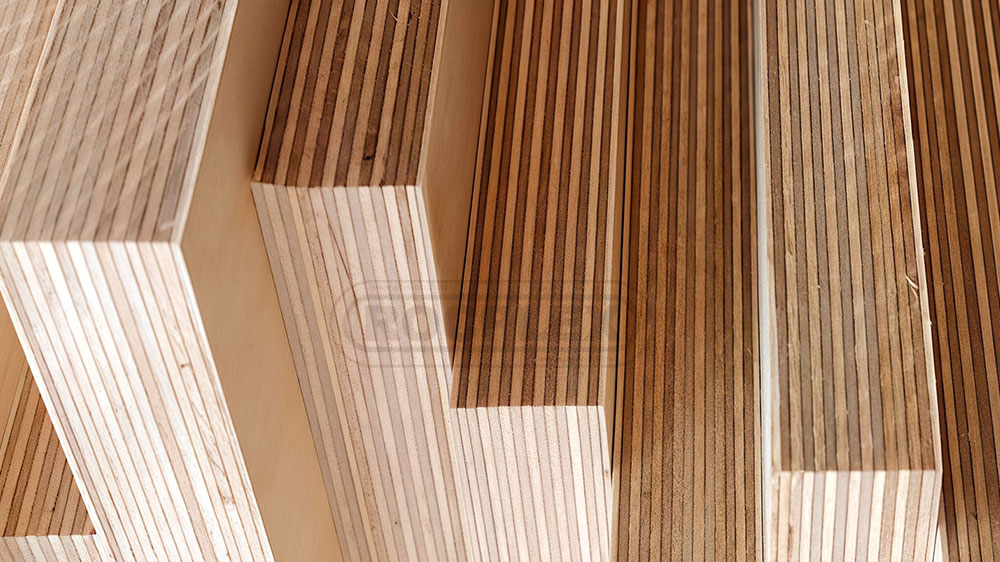
“Heavy panel” may mean a shelf resisting deflection, a cabinet side carrying hardware, a bench taking impact, or a fixture moved between sites. These are different problems.
For impact or repeat handling, edge damage may matter more than span. For a bench, surface wear and replaceability may matter more than appearance. The buyer should replace “heavy” with a measurable service condition.
State the component size, load type, support, fixing, exposure, finish, and expected handling cycle.
When Another Thickness Is the Better Choice
Choose 12mm when the component has close support, moderate fixing needs, and a strong reason to reduce weight. This often suits backs, dividers, wall linings, and smaller boxes.
Choose 15mm or 16mm when hardware, cut yield, weight, or an established product system makes that thickness more efficient.
Choose 21mm or thicker when the design needs more section depth, deeper machining, or more fixing material. Greater thickness still does not replace product grade or engineering data.
Core Construction Decides Whether 18mm Machines Cleanly
Two 18mm panels can behave very differently on the same CNC line. One may produce clean grooves and stable edges. Another may chip, expose voids, or vary enough in thickness to disrupt assembly.
Before approval, inspect the four edges and make representative cuts. Check veneer continuity, glue lines, overlaps, internal gaps, face thickness, and variation across several sheets.
The plywood grade guide helps separate face appearance from structural or performance claims. For exposed edges, add a specific visual core requirement rather than relying on the word “hardwood.”
Write the Purchase Order Around the Component
A useful order description should explain what the panel will become.
- Final component and application
- Structural or non-structural product type
- Finished length, width, and nominal thickness
- Thickness tolerance
- Face and back grade
- Core species or construction
- Core-gap and exposed-edge requirements
- Glue bond and service environment
- Machining and hardware details
- Surface coating or overlay
- Required product marking and documents
- Packing, bearers, wrapping, and sheet count
The EWPAA Structural Plywood and LVL Design Guide makes the same boundary clear at the structural end of the market. Product construction, face-grain direction, stress grade, support, and design data must work together.
A purchase line that says only “18mm plywood” is not enough for a rated application.
Questions Buyers Ask Before Ordering
Is 18mm plywood good for cabinet carcasses?
Yes, it is a common starting thickness for robust cabinet sides, bases, partitions, and fixtures. Confirm the core, hardware, machining, face grade, and finished component design.
Can 18mm plywood be used for shelves?
It can suit many shelves with planned support and load. Long or heavily loaded shelves may need a stiffened front edge, centre support, or thicker solution.
Is 18mm plywood suitable for flooring?
Only when the product and floor system are specified for that use. Confirm structural grade, marking, edges, orientation, support spacing, fixing, and exposure.
Is 18mm plywood waterproof?
No. Thickness does not make plywood waterproof. Bond class, treatment, surface protection, sealed edges, and construction detailing control moisture performance.
Is 18mm plywood the same as three-quarter-inch plywood?
They are close but not identical. Confirm finished thickness and tolerance before using fixed hardware, grooves, or imported drawings.
Buy the Component Performance
The most reliable 18mm plywood uses come from matching panel depth with core quality, hardware, support, finish, and service conditions.
ROCPLY can prepare an 18mm plywood specification around the finished component rather than a generic sheet description. Send the cut list, application, hardware, finish, quantity, and delivery market for a sample and quotation plan.
Need an 18mm Plywood Component Specification
Send your cut list, application, hardware, finish requirement, order quantity and destination market. ROCPLY can prepare a sample, product specification, packing plan and quotation.
Post time: Jul-27-2026