
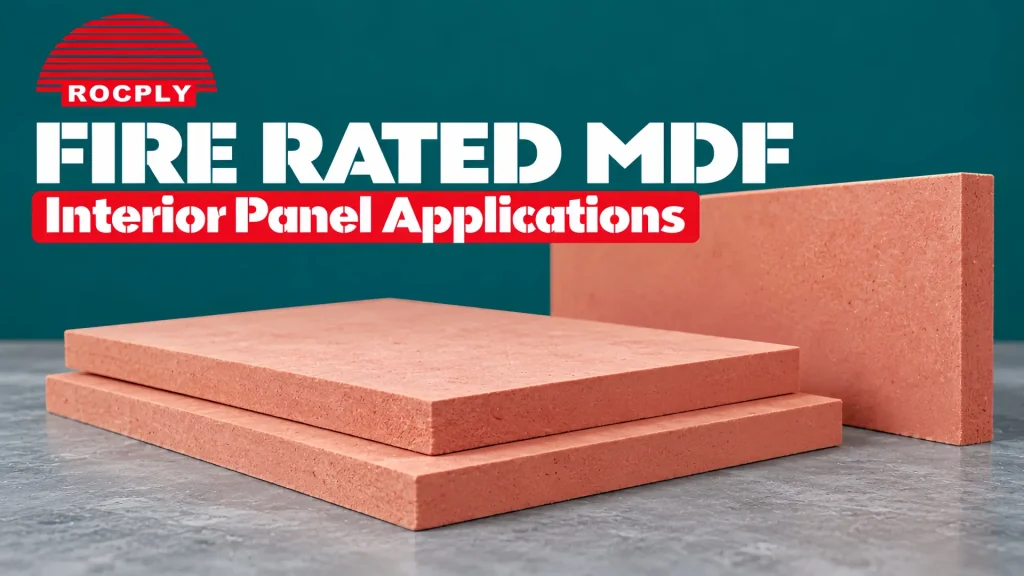
Fire rated MDF usually means a flame-retardant MDF product offered for a stated fire performance class. Specify that class and its test basis first. Then match the evidence to the finished panel and installation. A lining’s fire hazard class, a wall’s fire-resistance level and non-combustibility each answer different questions.
The useful buying question is whether the proposed product matches the required use. An order for “18mm fire rated MDF” leaves the finish, machining and mounting open. Those details belong in the specification before the board enters production.
Name the fire question first
| Question | Evidence to identify | Do not substitute |
|---|---|---|
| How does a lining contribute to fire growth and smoke? | Relevant reaction-to-fire or fire hazard classification | A time rating for a wall or door |
| How long does a building element meet fire-resistance criteria? | An FRL or other required system fire-resistance evidence | A lining Group number |
| Does a material satisfy a non-combustibility requirement? | The evidence required for that separate requirement | A flame-retardant product name |
The CSIRO fire safety guideline explains these separate concepts. An Australian FRL records periods in minutes for structural adequacy, integrity and insulation, in that order. A Group 1 lining claim does not provide those periods.
Also name the classification system. An EN 13501-1 Euroclass is not an Australian Group number. Submit the evidence required by the project rather than translating a class through a sales label.
Where fire rated MDF can fit
| Proposed use | Specification question |
|---|---|
| Interior wall or ceiling lining | Does the evidence cover this finished lining and mounting arrangement? |
| Decorative fit-out or display panel | Which fire requirements apply to the item and its location? |
| Slotted, perforated or acoustic panel | Does the scope cover the pattern, backing and cavity? |
| Component in a fire-resisting wall or door | Does the documented system permit this exact component and detail? |
For an Australian example, NCC 2022 Specification 7 links lining Group numbers to AS 5637.1. Its requirements depend on building use, location and sprinkler provisions. Smoke requirements also need review.
Have the project building surveyor or fire engineer confirm the applicable NCC edition and local provisions. Then review our fire rated MDF product enquiry against that written requirement. A room name alone cannot settle the choice.
Read the scope as closely as the class
A report headline can hide a narrow range of uses. Read the specimen description, result, limitations and supporting drawings together. Check these entries against the proposed order:
| Report entry | Match to the order |
|---|---|
| Product identity | Manufacturer, product code, grade and manufacturing source |
| Fire result | Exact classification, test basis and relevant smoke result |
| Panel scope | Permitted thickness range and other stated product limits |
| Surface and processing | Coating, veneer, laminate, adhesive and profile |
| Installation | Substrate, joints, fixings, cavity and backing |
| Document authority | Report number, issuing body, issue date and applicable test scope |
Ask for the full report or assessment, including referenced documents. Check the issuing laboratory’s relevant accreditation scope and any limits on the assessment. A brochure, logo or cropped certificate cannot fill missing technical detail.
Finally, confirm that the evidence remains relevant to the product now offered. Check revisions, product changes and any stated validity conditions. The issue date alone cannot establish that the report covers the current offer.
Check the role of each document
First, identify what the document actually is. A test report records a tested specimen and result. An assessment may extend evidence within stated conditions. A product certificate has its own scope, conditions and status. Keep those roles clear when reviewing a bundle.
Then check the links between the documents. An assessment that cites a test needs that test’s identity. A certificate naming a product family may still limit a finish or installation. Ask the issuer to clarify any gap.
Also distinguish a sales statement from technical evidence. “Tested to” names a method; it does not state the result, classification or field of use. Put the accepted document references into the purchase specification.
Thickness and finish can change the answer
A named manufacturer’s data shows why the details matter. The MEDITE PREMIER FR data sheet declares B-s2,d0 for 9mm and B-s1,d0 for 18mm, under its stated conditions. It also warns that standard coatings may affect the final rating.
Those are that manufacturer’s declared classes, not ROCPLY test results or an Australian Group classification. They illustrate why a generic “FR MDF” description leaves too much unresolved.
For your fire rated MDF order, record the allowed thickness and full finish system. Include primer, topcoat, veneer or laminate and adhesive where relevant. Ask whether the report covers the proposed combination. A claim for the bare core does not automatically extend to every decorative face.
A slotted panel is a new scope question
Consider an illustrative change from a plain 18mm panel to a slotted 18mm panel on battens. Add a fabric backer and a new adhesive. The nominal thickness stays the same, while several parts of the fire specification change.
Mark the differences on a revised section drawing. Then ask the report issuer or competent assessor whether existing evidence covers them. Obtain further evidence where needed. A difference calls for review; it does not, by itself, prove a pass or failure.
For products such as our grooved MDF wall panels, specify the profile and remaining section. Include open area, backing, joints and cavity details where relevant. Cutting and routing instructions must come from the selected product and documented system.
Keep other board properties in the order
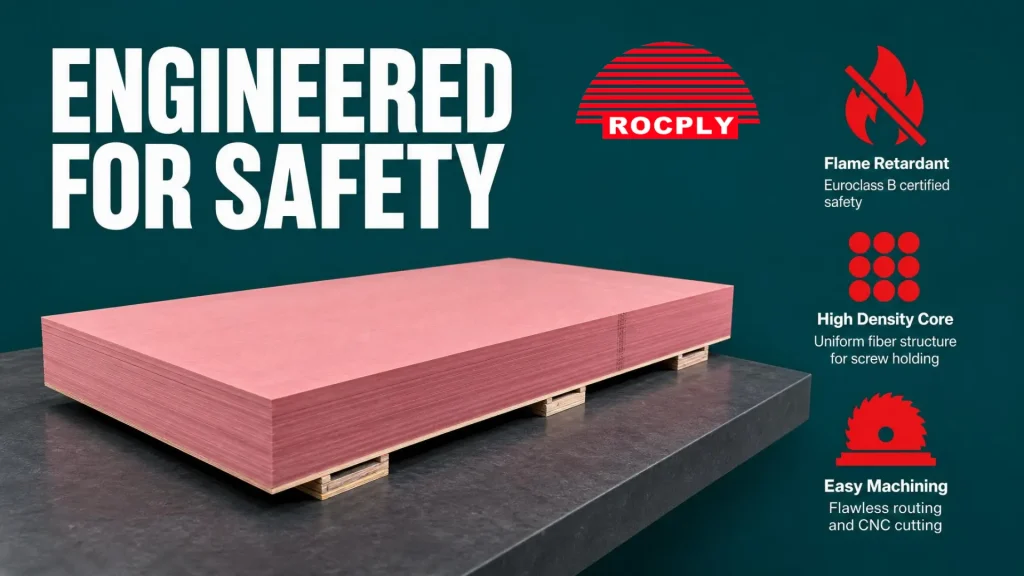
Fire performance does not settle moisture exposure, fixing capacity or emissions requirements. Check those properties for the actual product. Our moisture-resistant MDF guide covers a separate selection question; an MR designation alone provides no fire classification.
Also check the panel’s mass, support needs and machining quality. Store and condition sheets as the maker directs. Site moisture or damaged faces can affect fit and finish even when the specified fire evidence is in place.
Set an approval point before production
Before production, freeze the approved material and section drawing. It is easier to review a proposed veneer or adhesive before the factory buys it. A late change can affect both the coating line and the fire submission.
For example, a customer may approve a colour sample while the fire reviewer approves a raw-panel report. Those approvals cover different things. Bring the colour, construction and evidence into one accepted specification.
Then agree who signs off a substitute. A supplier can provide supporting product documents. The project team decides whether they satisfy the project brief.
Make the evidence follow the packs
Link approved fire rated MDF to the purchase order, pack labels and delivery record. Keep the product code and batch identification available through cutting and installation. Where labels disappear during processing, use job records to preserve that link.
- Keep the accepted report, specification and drawing revision in the job file.
- Check delivered product identity and thickness before cutting.
- Record the finish, adhesive, profile and installation details actually used.
- Refer substitutions for technical review before release.
- Include the relevant evidence and limits in the handover file.
A traceable pack does not mean every sheet received an individual fire test. It connects the supplied material to the approved evidence. Agree how that connection will be maintained before placing repeat orders.
Questions about fire rated MDF
Does Group 1 MDF mean a 60-minute wall?
No. A lining Group number and a system fire-resistance period address different properties. A wall or door needs evidence for its complete construction and the required criteria.
Can fire rated MDF be painted or veneered?
Only within the supported finish specification. Confirm the face material, adhesive, coating system and application details. Obtain technical review where the proposed finish falls outside the existing scope.
Does a red core prove a fire class?
No. Colour can help identify a product range. It does not replace the product name, marking and relevant fire documentation. Match the supplied board to the evidence.
Request fire rated MDF documentation
Send ROCPLY the intended use, project location, required classification, panel size, finish, machining and mounting details. Add quantity and destination. Request the available fire rated MDF documents for review against that brief before approving the order.
Request Fire Rated MDF Documentation
Post time: Nov-16-2026