

Plywood vs MDF is one of the most important material choices for cabinet makers, furniture factories and trade buyers. Both panels can produce good furniture. However, they respond very differently to hinges, shelves, paint, moisture, cut-outs and repeat handling.
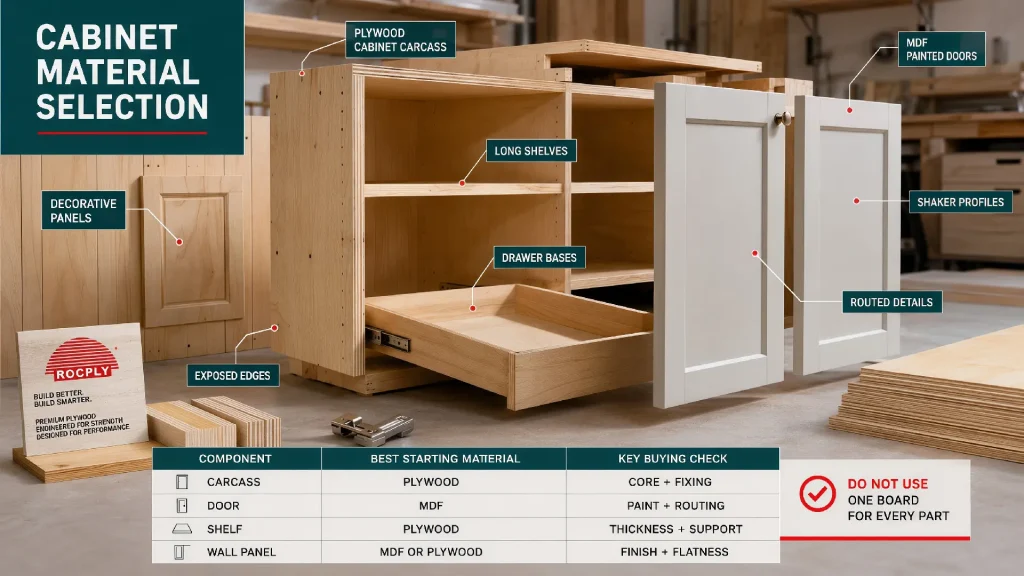
Plywood is often the better starting point for cabinet carcasses, shelves, exposed edges and parts that need firm hardware fixing. MDF is often the better starting point for painted doors, routed profiles and dry interior parts that need a very smooth finish.
The right choice depends on the component, not just the sheet price.
Quick Answer
Choose plywood for cabinet carcasses, shelves, structural furniture parts, timber-look furniture and components that need stronger edge fixing. Choose MDF for painted cabinet doors, routed decorative panels, interior mouldings and flat surfaces that need a smooth painted finish.
Plywood uses cross-laminated veneers. This can provide useful stiffness and reliable fixing performance when the core, thickness and support layout suit the job. MDF has a more uniform fibre core. This makes it well suited to smooth machining, routing and paint preparation.
A plywood vs MDF decision should be made part by part. Cabinet doors, shelves, carcasses, drawer bottoms and decorative wall panels do not need the same panel properties.
Plywood vs MDF Comparison for Cabinet Buyers
| Buying Factor | Plywood | MDF | Better Starting Choice |
|---|---|---|---|
| Cabinet carcasses | Good core options and durable fixing zones | Suitable for dry, well-supported carcasses | Plywood for demanding carcasses |
| Painted doors | Can be painted but may need more face preparation | Smooth and uniform paint surface | MDF |
| Routed profiles | May chip depending on face veneer and core | Machines into clean detailed profiles | MDF |
| Shelves | Often suitable for longer spans and heavier loads | Best with closer support or shorter spans | Plywood |
| Screw holding | Often stronger with a quality veneer core | Needs suitable screws and controlled fixing | Plywood |
| Exposed edges | Can create an attractive layered edge | Usually needs paint, tape or edge treatment | Plywood |
| Timber-look furniture | Good for clear coating and visible veneer detail | Usually needs veneer, laminate or paint | Plywood |
| Moisture risk | Depends on bond, edge treatment and panel type | Standard MDF should remain dry | Plywood with a suitable bond |
| Sheet consistency | Depends on core and veneer quality | Uniform fibre core and flat face | MDF |
| Weight | Varies by wood species and core | Often heavy for its thickness | Depends on handling needs |
This table provides a useful starting point. It does not replace a product specification. Low-quality plywood can still have core gaps, uneven thickness or poor machining results. MDF can also perform very well in dry interior furniture when density, thickness, fixing and finish are controlled.
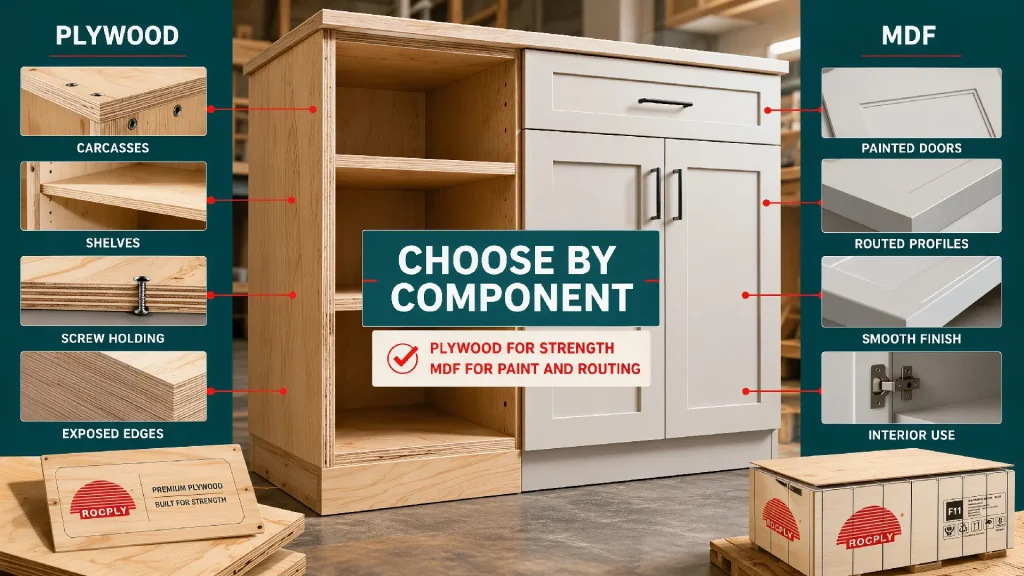
Choose the Material by Cabinet Component
A cabinet is not one single panel. A door needs a smooth face. A carcass needs reliable fixing points. A shelf needs stiffness. A drawer bottom needs flatness. Therefore, a plywood vs MDF decision should start with the job of each component.
Cabinet Carcasses
Plywood is often the safer choice for carcasses that carry weight, support hinges, receive repeated screws or move through a long supply chain. A stable veneer core can provide a stronger base for hardware and edge fixing.
MDF can work for dry interior carcasses, especially where the design uses close supports and controlled fixing. However, buyers should check panel density, thickness, hardware position and edge treatment before using MDF in heavy cabinetry.
For kitchens, wardrobes and commercial joinery, check the expected load, shelf span, hinge type, humidity level and transport risk before selecting the carcass material.
Cabinet Doors
MDF is widely used for painted cabinet doors because it has a smooth and even surface. It can be routed into shaker profiles, grooves, raised details and decorative patterns. It also gives a consistent surface for paint preparation when cut edges are sealed correctly.
Plywood cabinet doors can suit designs that celebrate natural veneer, layered edges or a clear-coated timber surface. They can also suit doors that need a stronger edge or more impact resistance.
For painted doors, MDF is usually the best starting point. For natural timber finishes, veneer-faced plywood can create a more authentic result.
Shelves and Long Horizontal Parts
Plywood is often the stronger starting point for shelves, benches, retail displays and long horizontal furniture parts. Its cross-layered structure can help control deflection when thickness, core and support layout are appropriate.
MDF can work for shelves. However, long unsupported spans may need more support, thicker boards, front edging or brackets. A shelf that looks fine on installation day can sag when books, tools or products are added later.
Before choosing shelf material, use the thickness selection resource to compare panel depth with the intended load and support arrangement.
Drawer Parts and Back Panels
Thin MDF can work well for drawer bottoms and supported cabinet backs in dry interior furniture. Thin plywood can suit drawer bases, cabinet backs and parts that need better impact resistance during transport or assembly.
The better option depends on the assembly method. Stapled backs, grooved backs, routed channels and screw-fixed parts each place different demands on panel edges and cores.
When Plywood Is the Better Choice
Plywood is often the better choice when a furniture part needs a stronger core, more durable edges or visible timber character.
- Cabinet carcasses with heavy hardware
- Long shelves and display units
- Furniture with exposed plywood edges
- Veneered or clear-coated furniture
- Retail fixtures with higher impact risk
- Parts that need repeated screw fixing
- Furniture that must handle transport and installation stress
- Controlled humid interior areas with the correct bond and finish
When a plywood vs MDF decision comes down to carcasses, shelves or hardware-heavy parts, plywood often provides a more reliable starting point.
Core quality remains important. A tight and balanced veneer lay-up supports cleaner cutting, better edge finishing and more dependable hardware fixing. Buyers should inspect core quality, face condition, thickness tolerance and flatness before approving a repeat program.
For timber-look finishes, review ROCPLY material options for decorative furniture.
When MDF Is the Better Choice
MDF is often the better choice when the project needs a smooth painted surface, detailed routing or consistent machining across many identical parts.
- Painted cabinet doors
- Routed shaker doors
- Decorative wall panels
- Interior mouldings
- CNC-cut patterns
- Flat painted furniture parts
- Speaker boxes and controlled interior components
- Cabinet panels that will be fully painted or laminated
MDF has a uniform fibre structure. This can produce clean routed details and a consistent paint base. However, cut edges need proper sealing before painting. A poorly sealed edge can absorb finish and create a rough surface.
For painted furniture programs, review the ROCPLY MDF panel range before confirming density, thickness, finish and moisture requirements.
Moisture Risk Changes the Decision
Plywood vs MDF also changes when moisture becomes part of the project risk.
Standard MDF should be used in dry interior conditions. Moisture can enter exposed edges, swell the fibre core and damage the paint or laminate finish. Moisture resistant MDF can offer improved performance in selected humid interior areas. However, it should not be treated as a fully waterproof or exterior panel.
Plywood can also fail in moisture if the wrong bond, core or finish is selected. A plywood sheet is not automatically suitable for wet service just because it contains veneers. Confirm the glue bond, edge treatment, intended exposure and panel specification.
For kitchens, laundries and other humid zones, specify the board, finish, cut-edge treatment and installation method together. Avoid relying on broad words such as “waterproof” without product data.
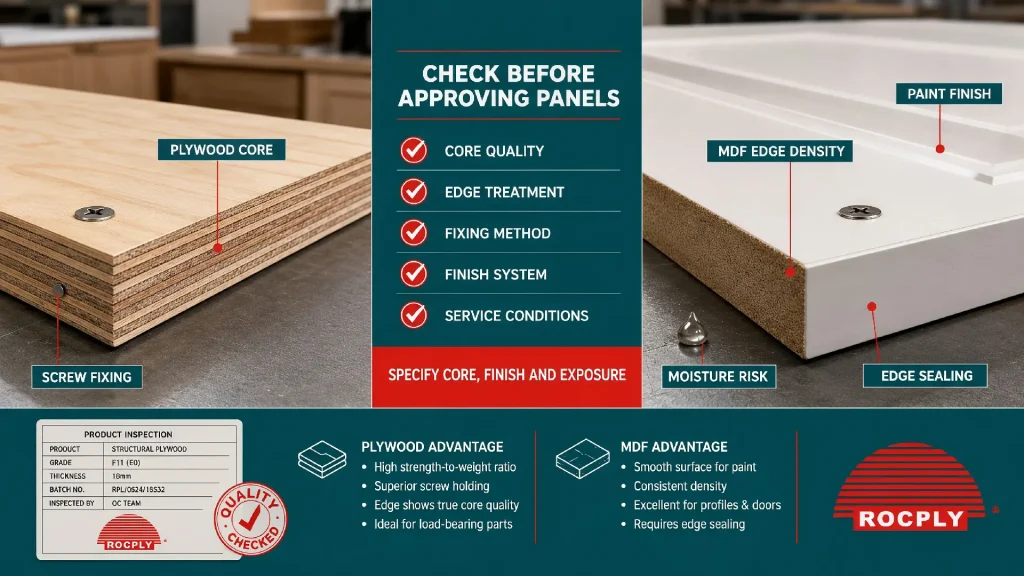
Thickness Core and Finish Matter More Than Buyers Expect
A cabinet buyer should not order only “18mm plywood” or “18mm MDF.”
For plywood, specify face and back grade, veneer species or surface requirement, core type, glue bond, thickness tolerance, sheet size, surface finish, emission requirement and packing standard.
For MDF, specify board grade, density range, thickness tolerance, moisture resistance requirement, surface condition, emission requirement, intended finish, edge sealing method, pack quantity and protection.
A clearer specification reduces rework. It also makes supplier quotations easier to compare.
Look Beyond the Sheet Price
In a plywood vs MDF cost review, the lower sheet price does not always create the lower finished furniture cost.
Plywood often costs more than standard MDF. However, a suitable plywood carcass can improve edge durability, hardware fixing and transport resistance. It can also create a premium exposed edge, which may reduce additional edging or finishing work.
MDF can reduce sanding and paint preparation on flat painted surfaces. It can also improve repeatability for routed doors and decorative machining. This may reduce workshop time in painted furniture programs.
| Cost Factor | Plywood | MDF |
|---|---|---|
| Material cost | Often higher for premium veneer-core panels | Often lower for standard interior boards |
| Paint preparation | May need more preparation for painted finishes | Often efficient for painted surfaces |
| Edge finishing | Can remain exposed or clear coated | Usually needs paint, tape or edging |
| Hardware fixing | Often reliable with a suitable core | Needs suitable screws and fixing detail |
| Moisture failure risk | Depends on bond, edge treatment and panel type | Higher risk with standard MDF |
| Visual value | Strong for timber and layered-edge designs | Strong for painted and routed designs |
The best material is the one that reduces total project risk, not only the one with the lower sheet cost.
A Better Buying Specification for Cabinets
- Cabinet component or furniture use
- Sheet size and thickness
- Material type and grade
- Surface finish requirement
- Core or density requirement
- Moisture exposure level
- Hardware and fixing method
- Edge treatment
- Quantity and packing requirement
- Delivery market and required documents
This information lets a supplier recommend a suitable panel instead of guessing from a short request.
Common Material Selection Mistakes
One common mistake is using standard MDF in a wet or poorly ventilated area. Another is choosing low-grade plywood only because the sheet looks thick.
Buyers also make mistakes when they use MDF for long shelves without enough support. Others use plywood for painted routed doors without allowing for face preparation.
The solution is simple. Select the material by component. Then check the core, finish, thickness, fixing method and service environment.
Questions Buyers Often Ask
Is Plywood Better Than MDF for Cabinets
Plywood is often better for cabinet carcasses, shelves, heavy hardware and exposed-edge furniture. MDF is often better for painted doors, routed panels and smooth interior finishes.
Is MDF Good for Kitchen Cabinets
MDF can work well for painted kitchen doors and dry interior cabinet parts. In humid zones, use a suitable moisture resistant grade, protect cut edges and confirm the full installation method.
Does Plywood Hold Screws Better Than MDF
Quality plywood often provides a more reliable starting point for repeated edge fixing and cabinet hardware. MDF needs suitable screws, pilot holes, edge distance and controlled tightening.
Is MDF Better for Painted Cabinet Doors
Usually, yes. MDF is often preferred for painted doors because the surface is smooth, uniform and easy to route into detailed profiles.
Should I Use Plywood or MDF for Shelves
Use plywood for longer shelves, heavier loads and exposed-edge furniture. MDF can work for shorter shelves with close support, edging or brackets.
Technical References for Cabinet Material Selection
For MDF properties, machining and finish considerations, review the technical resource from the Composite Panel Association.
Structural or load-bearing plywood work, use project-specific design data together with the WoodSolutions structural plywood fact sheet.
For broader plywood product information, review APA product information for plywood panels.
Choose the Best Material for Each Furniture Part
Plywood vs MDF does not have one overall winner. The best result comes from selecting the right panel for each furniture component.
Use plywood where core strength, screw holding, visible timber and edge durability matter. Use MDF where paint quality, routing and smooth surface finish matter most.
ROCPLY supports cabinet makers, furniture factories and trade buyers with panel selection, product samples, packing plans and quotation support. Share your application, finish, sheet size, thickness, quantity and target market to receive a suitable material recommendation.
Need a Cabinet Material Comparison?
Send your cabinet design, surface finish, hardware requirement, thickness, quantity and target market. ROCPLY can recommend a suitable plywood or MDF panel specification for your furniture program.
Post time: Jul-01-2026