
Plywood grades can seem simple until you compare quotes from different suppliers. One supplier may offer A/B plywood. Another may offer F17 structural plywood. A third may list BB/BB birch plywood or exterior bond plywood. These labels do not all measure the same thing.
This guide explains plywood grades in a practical way. It helps builders, furniture factories, distributors and project buyers choose the right panel without paying for the wrong feature.
Quick Answer
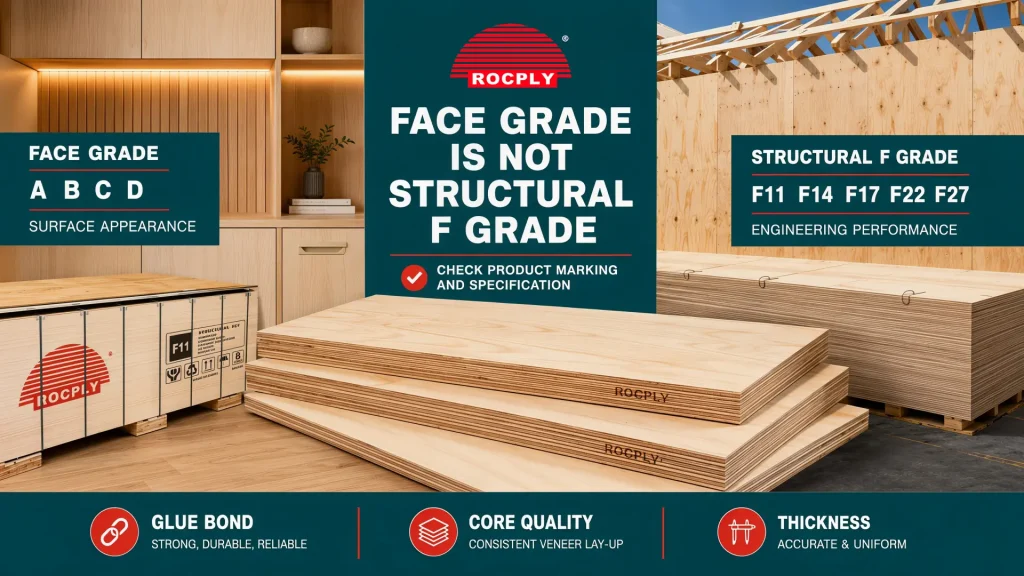
Plywood grades fall into several different systems. Face grades describe how the surface looks. Structural grades describe certified engineering performance. Bond types describe moisture resistance. Core quality affects machining, screw holding and panel consistency. Thickness affects stiffness, but it does not confirm a structural rating.
For furniture, choose plywood by face quality, core consistency, sanding level and finish requirement. For construction, choose certified structural plywood by the required grade, panel mark, support layout, thickness and project design. Never assume that a clean A-grade face means a panel is structural. Never assume that a high F-grade panel has a furniture-quality face.
Why Plywood Grades Confuse Buyers
The word “grade” is used in many ways. That creates problems when buyers compare products only by a short quote line.
A face grade such as A/B or B/BB often refers to the visible quality of the front and back veneers. It helps buyers select a panel for painting, staining, laminating or clear finishing.
A structural designation such as F11, F14, F17, F22 or F27 refers to a separate performance system. It is used where the plywood must carry load or support a building function. The exact choice must match the project design, span, fixing pattern and applicable product data.
A bond description refers to how the panel should perform in moisture conditions. It does not prove that the panel can carry structural load.
Choose plywood by the job requirement first. Then confirm the correct grade system for that requirement.
The Six Plywood Grade Checks Buyers Should Separate
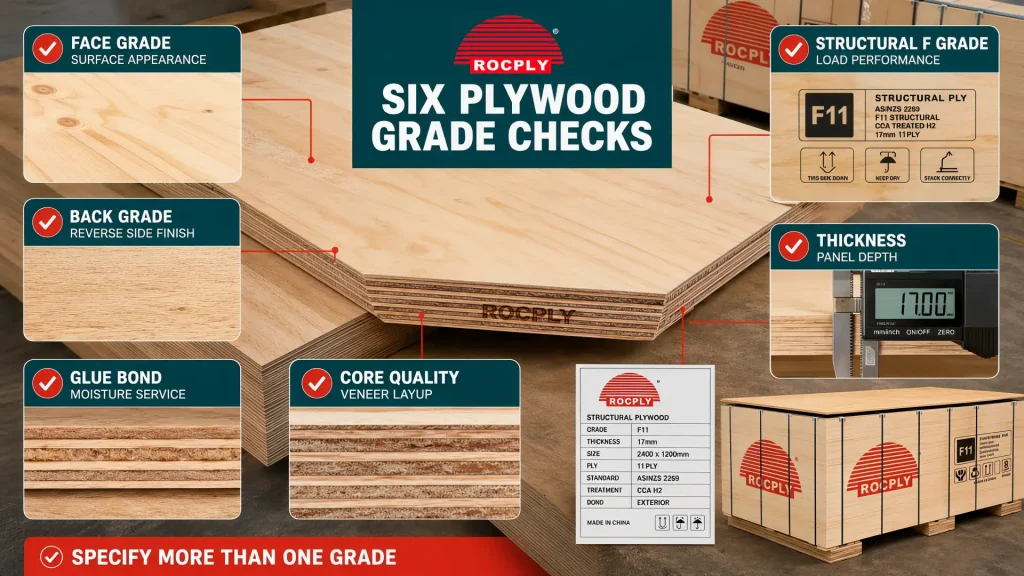
| Grade or Property | What It Tells You | Best Used For | What It Does Not Prove |
|---|---|---|---|
| Face grade | Surface appearance, patches, knots and sanding quality | Furniture, wall panels and visible joinery | Structural strength |
| Back grade | Appearance of the reverse side | Cabinet backs, hidden faces and one-sided panels | Core quality or load capacity |
| Structural F grade | Certified structural performance category | Floors, walls, roofs, bracing and engineered work | Furniture face quality |
| Bond type | Suitability for moisture exposure | Interior, humid, exterior or wet-use conditions | Structural rating |
| Core quality | Layer consistency, machining value and screw holding | Furniture, cut parts and repeat production | Formal structural certification |
| Thickness | Physical panel depth and general stiffness | Shelves, cabinets, wall lining and supported panels | Grade, bond class or design capacity |
A good plywood quote should show more than one line. It should state the product type, thickness, sheet size, face and back grade, core, glue bond, intended use and required certification.
Face Grades for Furniture and Visible Work
Face grades matter when buyers will see the panel after installation. They influence the amount of patching, sanding, filling, staining and finishing work needed.
A-grade faces are often selected for clean visible work. They usually suit high-end clear finishes, decorative panels, premium furniture and surfaces where the timber look matters.
B-grade faces may allow small sound patches, colour variation or limited natural defects. They can work well for painted furniture, cabinetry, shelving and many commercial joinery programs.
C-grade and D-grade faces are usually more suitable for hidden work, utility panels, backing, temporary use, packaging or projects where surface appearance is not important.
However, letter grades are not identical across every country, supplier, veneer species or product standard. An A/B panel from one supplier may not look exactly like an A/B panel from another supplier.
- A face sample
- A back-face sample
- The accepted patch and knot standard
- Sanding level
- Veneer species
- Core specification
- Moisture content range
- Colour and grain expectations
For clear-coated furniture, a beautiful face is important. Yet the core still matters. A premium veneer over an unstable core can create machining, edge-banding and flatness problems later. Review ROCPLY Furniture Plywood options when the finished face is part of the project value.
Structural Plywood Grades for Construction
Structural plywood should be selected by its certified performance information, not by visual appearance.
F-grade plywood is used in structural applications where the panel must perform as part of a designed building system. ROCPLY structural plywood programs may include grades such as F11, F14, F17, F22 and F27, depending on the product and intended use.
A higher F-grade does not automatically mean “better” for every project. It means the panel belongs to a higher structural performance category within the relevant grading system. The correct choice still depends on span direction, support spacing, panel thickness, fastening pattern, load type, moisture exposure, wall, floor or roof design, product certification and panel marking.
For example, a clean A/B furniture panel may look better than a structural panel, but it may not be certified for bracing, roof decking or flooring. In the same way, an F17 structural panel may be suitable for demanding construction work, while its face may not suit a high-end clear furniture finish.
Use ROCPLY Structural Plywood for projects that require a structural product path. Use a project-specific design schedule and the relevant product documentation before final selection.
Bond Core and Thickness Still Matter
A plywood grade should never be selected in isolation.
The glue bond must match the service condition. Interior furniture in a dry room has different needs from a bathroom cabinet, exterior soffit, transport floor or concrete form.
The core affects how the panel cuts, screws, stays flat and performs in repeat production. Tight veneer lay-up, controlled thickness and low void content are important for cabinet parts, CNC processing and large-format panels.
Thickness also matters. A 12mm sheet can suit wall lining and many fit-out parts. An 18mm sheet can suit cabinet carcasses, shelves and furniture frames. Still, thickness alone does not confirm structural use.
Review the ROCPLY Plywood Thickness Chart before selecting panel depth. For structural work, pair thickness with the correct certified grade and support design.
Match Plywood Grades to the Job
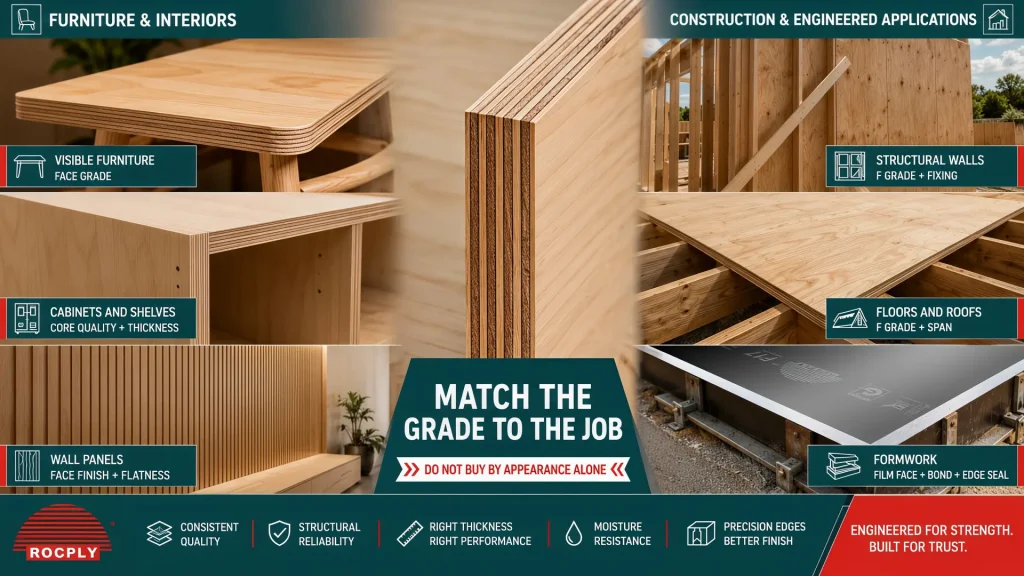
| Project Type | First Grade Priority | Other Important Checks |
|---|---|---|
| Clear-coated furniture | Face grade and veneer appearance | Core quality, sanding, colour consistency and flatness |
| Painted cabinet doors | Smooth sanded face | Density, machining quality, paint preparation and moisture exposure |
| Cabinet carcasses | Core consistency and screw holding | Thickness, face finish, edge treatment and hardware plan |
| Retail fixtures | Strength, flatness and surface quality | Load, support spacing, cut list and repeatability |
| Decorative wall panels | Face grade and veneer match | Sheet size, thickness, joint detail and finish |
| Wall bracing | Certified structural plywood | Project design, panel mark, fixing schedule and support layout |
| Floors and roofs | Structural grade and thickness | Span direction, fixing, edge detail and moisture protection |
| Concrete formwork | Purpose-made formply | Film face, edge seal, bond, strength grade and pour cycle plan |
| Crates and packaging | Cost-effective utility grade | Core, bond, nail holding and transport conditions |
The key is to avoid paying for the wrong grade. A premium furniture face may add cost without helping a hidden structural panel. A structural grade may add cost without improving a decorative table surface.
How to Write a Better Plywood Specification
A useful plywood order should not say only “18mm plywood.”
Instead, include the product use, sheet size, nominal thickness and accepted tolerance, face and back grade, veneer species or appearance requirement, core type, glue bond or moisture requirement, structural grade where required, surface finish, edge treatment, pack quantity, inspection requirements, shipping destination and required documents or certification.
This information makes quotation more accurate. It also helps prevent batch inconsistency, wrong face grades, packing damage and unsuitable substitutions. For structural projects, review ROCPLY’s Plywood Structural Sizes and Span Guide before locking the final panel schedule.
Common Plywood Grade Mistakes
The first mistake is treating face grade as strength grade. A clean-looking sheet may not be suitable for structural work.
The second mistake is treating thickness as a full specification. Thickness matters, but it does not tell you the core quality, glue bond, face grade or certification status.
The third mistake is using a generic label such as “waterproof plywood.” Ask what bond system, intended exposure and product documentation support that claim.
The fourth mistake is choosing a structural panel for a furniture surface without checking the face. Structural performance and decorative quality are separate purchasing decisions.
Questions Buyers Often Ask
Is A Grade Plywood Stronger Than B Grade Plywood
Not necessarily. A and B often describe surface appearance. Structural strength depends on the certified panel type, structural grade, thickness, span direction, core construction and product data.
Is F17 Plywood Better Than A B Plywood
They are not directly comparable. F17 refers to a structural performance grade. A/B refers to the appearance of the front and back faces. One panel may be F17 with a utility face. Another may be A/B with no structural rating.
What Plywood Grade Is Best for Cabinets
Choose a stable core, suitable thickness, smooth face and finish level that match the cabinet design. For clear furniture, face grade is more important. For painted cabinets, sanding quality and machining performance matter more.
What Grade Should I Use for Structural Walls
Use certified structural plywood that matches the design, support layout, fixing schedule and project requirement. Do not select structural wall plywood from face grade alone.
Does Exterior Bond Mean Structural Plywood
No. Exterior bond refers to moisture-related adhesive performance. It does not automatically confirm structural capacity or project compliance.
Technical References for Plywood Grade Selection
Choose Plywood by Specification Not by a Single Label
The best plywood grade is the one that matches the job without adding unnecessary cost or risk. Start with the application. Then check face grade, structural grade, glue bond, core, thickness, sheet size and packing requirement.
ROCPLY supports trade buyers with plywood specifications for construction, furniture, fit-out and export programs. Share your target application, size, grade, quantity and market. The team can help prepare a suitable panel recommendation, sample plan and quotation.
Post time: Jun-29-2026